Monday - Thursday
10:00AM - 9:00PM
Friday - Saturday
10:00AM - 10:00PM
Sunday
11:00PM - 8:00PM

 |
You're seven years old. It's a Sunday afternoon. The neighbour's backyard has a trampoline, and the next two hours feel like the best two hours of your entire existence. You're flying. You're laughing. Your stomach's doing that little flip thing. Your legs are pumping without you even thinking about it.
Now fast forward to today. You're dragging yourself to the gym, staring at a treadmill like it personally insulted you, and counting down the minutes until you're legally allowed to leave.
Here's the thing nobody told you... That seven-year-old was onto something.
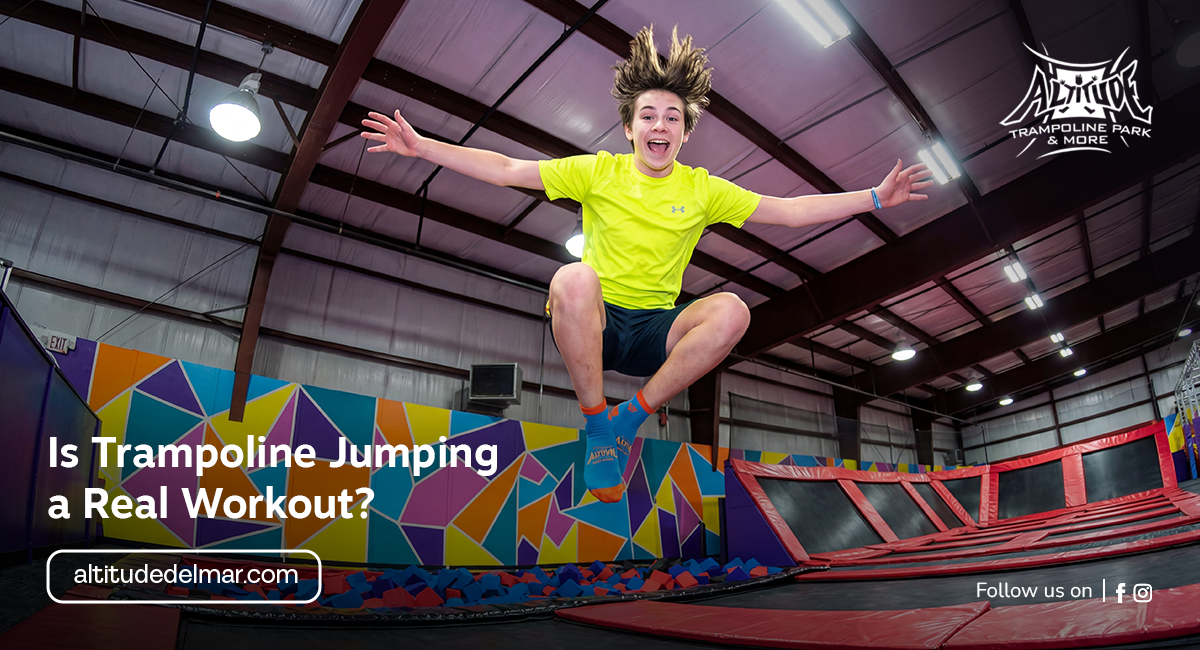
Trampoline jumping, also called rebounding, isn't just a childhood memory or a party trick. It's one of the most scientifically-backed, surprisingly effective workouts. And it's also... Genuinely fun. Like, stop-checking-your-phone fun.
Let's break down exactly why bouncing on a trampoline might just be the upgrade your fitness routine has been waiting for.
Back in 1980, NASA published a study in the Journal of Applied Physiology that stopped the fitness world in its tracks. Their researchers compared trampoline jumping to running, and the results were wild.
Rebounding was found to be 68% more efficient for cardiovascular fitness than jogging. Same time investment. Significantly better output.
That's not marketing fluff. That's aerospace scientists trying to figure out the best way to rehabilitate astronauts who'd lost bone density and muscle mass in zero gravity. And their answer? Bounce.
Think about that. NASA looked at every possible exercise option on the planet and said, "Yeah, the trampoline thing."
Let's start with the heart because everything starts with the heart.
Jumping on a trampoline gets your heart rate up fast. We're talking within minutes. The continuous up-and-down motion demands that your cardiovascular system keep pace, pumping oxygen-rich blood to working muscles nonstop.
What makes this different from, say, cycling or swimming? The variability.
On a trampoline, your body never fully settles into a rhythm it can coast through. Every bounce is slightly different. You're adjusting balance, shifting weight, controlling momentum and your heart is responding to all of it in real time. This kind of dynamic cardiovascular demand improves heart efficiency, lowers resting heart rate over time, and builds genuine aerobic capacity.
Twenty to thirty minutes of moderate rebounding can burn anywhere between 200 and 400 calories. It depends on your intensity and body weight. That's roughly equivalent to running at a moderate pace but with a fraction of the joint impact.
Speaking of which...
Here's where rebounding genuinely separates itself from almost every other high-intensity workout.
When you run on pavement or even a treadmill, each footfall sends a shockwave up through your heels, ankles, knees, hips, and spine. Over time that repetitive impact accumulates. It becomes worn. It becomes painful. It becomes the reason people quit.
A trampoline mat absorbs up to 80% of the shock from each landing. The elasticity of the surface acts as a natural buffer. It dramatically reduces the stress on your joints while still delivering the muscular and cardiovascular benefits of a full workout.
This makes rebounding one of the most joint-friendly high-intensity exercises. It's accessible to people recovering from injury. It's brilliant for older adults wanting to stay active without the grinding impact. It's a gift for anyone whose knees have started filing complaints.
You're still working hard. Your muscles are still firing. Your heart is still pumping. Your joints are just... Not screaming about it afterward.
This is the part that surprises most people. When you bounce on a trampoline, your body isn't just using your legs. It's using everything simultaneously without you having to think about it.
Here's what's actually happening when you rebound... Your legs are doing the obvious work. Pushing off, absorbing landing, stabilising. Your core are firing non-stop to keep you upright and balanced on an unstable surface. You can't cheat this. If your core switches off, you wobble. Your body knows this, so it doesn't let that happen. Your arms contributing to rhythm and balance, adding upper body engagement. Your stabiliser muscles are working overtime to respond to the constantly shifting surface.
The result? A full-body workout that builds functional strength. The kind that translates to real life. Better posture, balance, and coordination. The kind of strength that makes you feel capable, not just look capable.
Most people don't know their lymphatic system exists until something goes wrong with it. But here's why rebounding enthusiasts quietly call it a lymphatic supercharger.
Your lymphatic system is essentially your body's internal cleaning crew. It removes waste, toxins, and pathogens from your tissues and carries immune cells throughout the body. Unlike your cardiovascular system, it has no pump no heart equivalent to keep things moving. It relies entirely on muscular movement and gravity shifts to circulate.
And what movement repeatedly works with and against gravity in rapid succession? You guessed it.
The rhythmic up-and-down motion of bouncing creates continuous gravitational change that physically pumps the lymphatic system in a way very few exercises can replicate. This supports immune function, reduces bloating, speeds up the removal of metabolic waste, and contributes to that overall clean, energised feeling people report after rebounding sessions.
It's wellness you can literally feel.
Here's something the fitness world doesn't talk about enough... Exercise isn't just about the body. It's about training the brain.
Trampoline jumping is a proprioceptive workout. It constantly challenges your body's sense of where it is in space. Every bounce is a micro-adjustment. Every landing demands recalibration. Over time, this trains your neuromuscular system to become sharper, faster, and more responsive.
This translates to better balance and coordination in everyday life. The kind that helps you move confidently, reduces your fall risk as you age, and makes you a more athletic, body-aware person overall.
Studies have also shown that the rhythmic motion of bouncing can help reduce stress and anxiety. It also improves mood through endorphin release, and even support focus and mental clarity. There's something about the physical rhythm of rebounding that feels almost meditative. Once you get into it, the mental chatter tends to quiet down.
It's cardio meets mindfulness. And your brain absolutely loves it.
If you're thinking about your health ten, twenty, thirty years from now pay attention to this one.
Weight-bearing exercise is one of the primary drivers of bone density maintenance and growth. As we age, bone density naturally decreases, especially in women post-menopause. This increases the risk of fractures and osteoporosis.
Rebounding is classified as a weight-bearing exercise. The G-force experienced during each bounce places meaningful stress on bones. It respond by laying down new bone tissue and strengthening existing structure. The NASA study mentioned earlier specifically highlighted this benefit... Rebounding was shown to be significantly more effective at building and maintaining bone density compared to running, while still being gentle on joints.
So you're building strong bones without beating up your body to get there. That's the kind of trade-off worth making.
Let's be real about something. The best workout is the one you actually do. Consistently. Long-term. And the number one reason people quit exercise programs? They're boring. They feel like obligation. They feel like punishment for wanting to be healthy.
Trampoline jumping short-circuits that entirely.
There's a reason children on trampolines literally cannot stop smiling. The sensation of bouncing triggers genuine joy responses in the brain. It doesn't feel like exercise. It feels like play.
Research consistently shows that enjoyment is one of the strongest predictors of exercise adherence. When something is fun, you come back. When you come back consistently, results follow. The best fitness routine isn't the most extreme one it's the one you'll actually stick to.
Trampoline jumping is the rare workout that removes willpower from the equation entirely. You won't need to hype yourself up. You won't be clock-watching. You'll just be bouncing. And suddenly, thirty minutes will have passed, and you'll feel incredible.
.png)
Somewhere between "serious workout" and "ridiculously good time" lives trampoline jumping. And that's exactly what makes it special.
It torches calories. It strengthens your heart. It protects your joints. It works your full body. It cleans your lymphatic system. It sharpens your brain. It builds your bones. And it makes you feel like you're seven years old on a Sunday afternoon with nowhere else to be.
There are workouts that are effective. There are workouts that are enjoyable. Rebounding is genuinely, wonderfully both and that combination is rarer than it sounds.
So the next time fitness feels like a chore, remember... Sometimes the best thing you can do for your body is just jump.
Ready to bounce? Your body's been waiting.
The Funfull App
Search for the “Funfull” app and download. Once registered, enjoy your visits to all partnering entertainment venues!.png)
.png)