Monday - Thursday
10:00AM - 9:00PM
Friday - Saturday
10:00AM - 10:00PM
Sunday
11:00PM - 8:00PM

 |
Walk into almost any home today, and you’ll see the glow. A tablet on the couch. A TV humming in the background. A phone balanced in small hands. Screens have quietly become the default activity.
And while learning apps, creative tools, and staying connected absolutely have their place, there’s a growing challenge parents face every day "How do we keep kids genuinely active in a world built for sitting still?"
That’s where intentional movement-driven environments like Altitude Trampoline Park step in. Not as a lecture about limiting screen time, but as a compelling alternative kids actually want. This isn’t about forcing exercise. It’s about replacing passive entertainment with active joy.
Let’s break down exactly how that happens physically, socially, and emotionally.
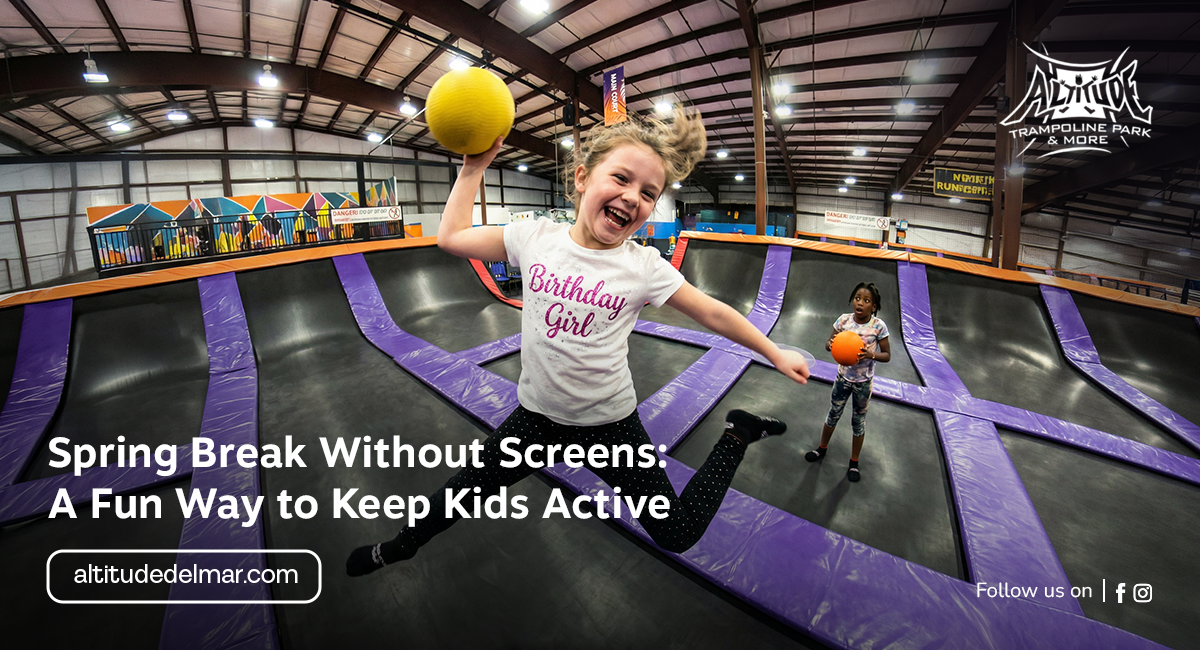
If you tell a child, “Let’s go work out,” you’ll likely get resistance. If you tell them, “Let’s go jump,” you’ll get shoes on in 30 seconds. Here, kids experience cardiovascular activity disguised as play.
What’s Happening Physiologically?
Jumping on trampolines
Elevates heart rate into aerobic zones
Engages major muscle groups
Improves circulation
Increases oxygen delivery to the brain
Enhances lymphatic drainage
NASA research has even shown that trampoline-based rebounding is highly efficient for cardiovascular conditioning. Yet kids don’t process it as “training.” They experience it as
Flying
Competing
Laughing
Challenging themselves
The mental framing changes everything. Instead of “I have to exercise.” It becomes “Watch this jump.” That mindset shift is powerful.
In child development, there’s a concept called physical literacy. It's the ability to perform competently and confidently in a variety of physical activities. It includes
Balance
Agility
Reaction time
Body awareness
Spatial coordination
Trampolines uniquely enhance all of these. Every jump requires micro-adjustments
Stabilizing the core mid-air
Controlling limb placement
Absorbing impact safely
Timing movements
Add in dodgeball courts, foam pits, and challenge zones, and kids are constantly adapting their motor patterns. Compare that to screen time, which largely involves
Minimal gross motor activity
Limited dynamic balance engagement
Static posture
The difference in neurological stimulation is significant. Active movement strengthens neural pathways between the brain and body. This improves coordination that carries into sports, playground confidence, and everyday tasks.
It’s not just energy burned. It’s skill-based.
There’s something deeply empowering about trying a new jump... And landing it. Altitude provides a controlled risk environment. This includes padded surfaces, supervision, and structured zones where kids can safely test their limits.
That matters.
When a child
Attempts a higher jump
Masters a flip
Wins a dodgeball round
Climbs and navigates obstacles
They experience micro-wins. Those small wins build self-trust, resilience, courage, and a growth mindset. Screens often reward children passively. Physical play rewards effort. There’s a fundamental difference between unlocking a digital badge and earning applause from peers after a bold attempt.
One is programmed validation. The other is embodied achievement. And that confidence doesn’t stay in the park. It travels into classrooms, friendships, and home life.
Screens are often solitary experiences, even when multiplayer. At a trampoline park, interaction is unavoidable in the best way.
Kids
Challenge each other
Cheer each other on
Negotiate turns
Laugh at shared fails
Form spontaneous teams
These are social skills in real time. Research from the Centers for Disease Control and Prevention emphasizes that physical activity in group settings improves physical health. It also enhances social development and emotional well-being.
Face-to-face play builds
Empathy
Communication
Conflict resolution
Teamwork
There’s eye contact. Tone of voice. Shared adrenaline. That kind of connection can’t be replicated through a screen.
Ever noticed how kids seem calmer after running around? That’s not accidental. Physical activity triggers the release of
Endorphins
Dopamine
Serotonin
These neurotransmitters regulate mood, reduce anxiety, and support focus. Jumping is rhythmic and repetitive. It can have a regulating effect on the nervous system. For kids who struggle with
Hyperactivity
Restlessness
Emotional outbursts
Screen overstimulation
An active outlet acts as a reset. Instead of suppressing energy, it channels it. And instead of overstimulating visually, it engages physically. Parents often report
Better sleep after active days
Fewer bedtime battles
Improved focus the next day
Movement isn’t just physical hygiene. It’s mental hygiene.
Outdoor play is wonderful, but the weather doesn’t always cooperate. Rainy days. Extreme heat. Winter cold. When outside isn’t an option, screens become the default fallback. Indoor trampoline parks eliminate that dependency.
They provide
Climate-controlled environments
Year-round availability
Predictable activity planning
This reliability helps parents reduce passive screen use without feeling stuck. Instead of “Well, we can’t go outside… just watch something.” It becomes “Let’s go jump.”
Consistency matters when building habits.
Healthy child development requires both
Free Play: Creative, self-directed exploration
Structured Play: Guided challenges and organized activities
Altitude blends both. Open jump sessions allow kids to
Experiment
Invent games
Test boundaries
Organized games and party events introduce rules, team dynamics, and achievement-based challenges. Screens often provide structure but limit creativity or allow creativity without physical engagement. Physical spaces allow both to coexist naturally.
That combination nurtures
Imagination
Discipline
Adaptability
It’s balanced stimulation.
One of the most complicated parenting challenges today isn’t limiting screens. It’s managing the resistance when doing so. But something interesting happens when an alternative is compelling enough. Kids don’t argue about leaving a tablet when they’re excited about going somewhere.
The goal isn’t deprivation. It’s substitution.
Instead of framing it as “No more screen time.” It becomes, “We’re going somewhere better.” When the alternative delivers
Adrenaline
Social fun
Physical thrill
Achievement
The transition becomes smoother. And when kids return home tired, fulfilled, and proud, screens feel less urgent.
Childhood habits shape adulthood patterns. When kids associate movement with
Fun
Celebration
Social bonding
Confidence
They’re more likely to continue seeking active experiences later in life. But if exercise is framed as an obligation, it often gets avoided long-term. Trampoline parks reframe physical activity as Joyful. And that reframe can have a lasting impact.
Parents often notice changes beyond the jump session
Improved appetite regulation
Deeper sleep
Reduced crankiness
Better sibling interactions
Active play helps burn off excess energy that might otherwise surface as restlessness, irritability, and screen dependency. Movement creates a healthier baseline. And that baseline affects the whole household.
(1).png)
If your goal is to gradually reduce passive screen time, here are actionable strategies
1. Trade, Don’t Remove: Swap one weekend movie block with a jump session.
2. Use it as a Reward: Tie visits to milestones such as reading goals, chore consistency, and school achievements.
3. Make It Social: Invite friends. Shared anticipation increases excitement.
4. Create a Routine: Monthly active outings build habit memory.
5. Pair It With Reflection: Afterward, ask, "What was your favorite jump?" "What felt hard but fun?"
This reinforces intrinsic motivation.
Technology will always be part of our world. The real question is, "Are we balancing passive consumption with active experience?" Places like Altitude don’t compete with screens through restrictions. They compete through experience.
Through laughter that echoes across padded floors. Through fearless mid-air attempts. Through sweat, teamwork, and celebration. When kids are moving, connecting, challenging themselves, and laughing in real time. They’re not thinking about screens. They’re fully present.
And in a distracted world, that might be the greatest benefit of all.
The Funfull App
Search for the “Funfull” app and download. Once registered, enjoy your visits to all partnering entertainment venues!.png)
.png)