Monday - Thursday
10:00AM - 9:00PM
Friday - Saturday
10:00AM - 10:00PM
Sunday
11:00PM - 8:00PM

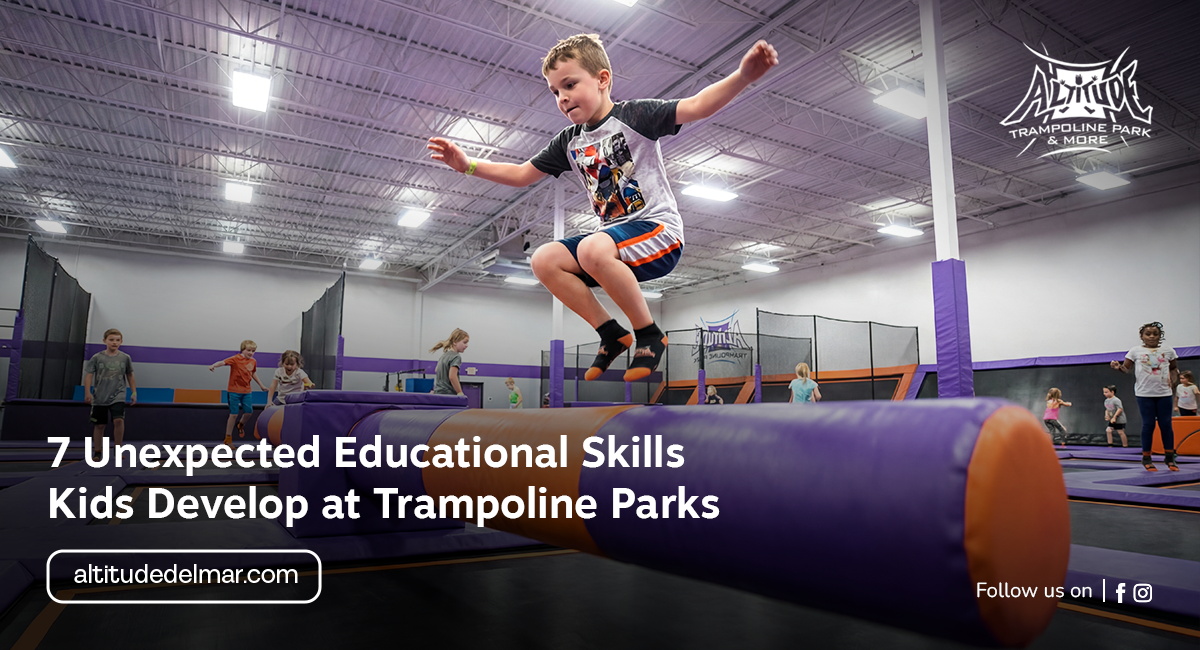 |
Think trampolines are only about airtime and giggles? Think again. When kids jump, race, and play in a well-designed trampoline park, they’re doing far more than burning energy. They’re practicing core skills that help them learn, think, and get along with others.
Below are seven unexpected educational skills kids build at trampoline parks, why they matter, and practical ways parents can notice and amplify the learning.
Every bounce, twist, and landing asks your child’s body to make tiny adjustments in real time. That trains the vestibular system, proprioception, and core strength. Over time, jumping on trampolines sharpens motor planning... The brain learns how to coordinate arms, legs, and eyes so the next move is smoother.
Balance and coordination are the building blocks for handwriting, bike riding, sports, dance, and many classroom tasks that demand fine and gross motor control. Kids who develop good body awareness tend to move with confidence and take on new physical challenges without fear.
A child lands with less wobble after several attempts.
They can link movements (run → jump → turn) fluidly.
Toddlers who used to be cautious begin experimenting with small hops.
Try short “balance challenges” like standing on one leg for a count, then switching.
Practice simple obstacle courses with cushions and pillows.
Encourage games that require catching or aiming. They improve hand-eye coordination.
Jumping boosts spatial reasoning... Kids estimate where they’ll land, how high to jump, and how to position their bodies relative to others and objects. That constant spatial problem-solving sharpens attention and timing.
Spatial skills are critical for geometry, measurement, reading maps, packing tasks, and even understanding number line concepts. Focus improved through dynamic play also supports classroom tasks that need sustained attention.
Kids' judgment, grabs, and landings are better after warm-up jumps.
They time their moves to music or to the rhythm of a game.
They navigate crowded zones with growing ease.
Play “mirror” games. One child copies another’s movement... It builds timing and observation.
Use rhythm-based activities to combine timing with attention.
At mealtime, ask spatial questions like, “How many plates fit in this tray?” It helps to tie play skills to everyday reasoning.
Trampoline places are dynamic environments... Obstacles change, bounce surfaces react differently, and friends create new rules. Kids must adjust plans, try alternate strategies, and recover when a move doesn’t work.
Problem-solving in play is an immediate and safe practice for flexible thinking, planning, and persistence. Kids learn to iterate and adapt to change without adult-led instruction.
A kid modifies a trick after a failed attempt rather than stopping.
Groups design new games or alter rules to make things fairer.
Children find creative ways to use park features for different games.
Turn failed attempts into experiments. “Okay, that didn’t work, what if we try this?”
Create simple engineering challenges with recyclables (build a tower that can survive a light bump).
Encourage “what if” brainstorming after play. What could we change to make it better?
Jump parks are social labs. Kids negotiate turns, explain rules, call out safety warnings, and cheer teammates. These interactions require quick, clear communication and active listening.
Effective communication is central to classroom learning and friendships. Kids who practice asking, explaining, and listening during energetic play get fluent in social negotiating and collaborative speech.
Children confidently call for “your turn” or “watch me.”
They explain the game rules to newcomers.
Siblings or friends coordinate strategy without adult prompts.
Role-play scenarios: practice asking for turns or saying “I’m ready” politely.
Use brief debriefs after play: “How did you tell your friend it was their turn?”
Teach simple scripts: “Can I try after you?” or “I felt upset when…”
Many trampoline-park games are team-based: dodgeball, relay races, group challenges. Kids take positions, follow group strategy, and sometimes lead play... Then step back to follow another’s lead.
Leadership and collaboration are life skills. Kids learn to be accountable, give direction, accept feedback, and celebrate group success. Those experiences directly transfer to classroom group work and future teamwork contexts.
One child organizes a relay, another cheers lead.
Groups elect roles naturally.
Children celebrate wins together, showing shared ownership.
Host family team games where roles rotate... Captain, timekeeper, and cheerleader.
Praise process-based leadership, “You helped the team by explaining the plan... Nice job.”
Let kids design a small team challenge and run it.
Active play releases endorphins and helps discharge physiological arousal. Through physical exertion and structured games, kids learn to manage excitement, frustration, and disappointment, and to regain calm after big moments.
Emotional regulation reduces meltdowns, improves focus, and supports resilience. Children who repeatedly practice calming down after high-arousal play can better handle classroom demands and social setbacks.
A frustrated child takes a breath and tries again after a fall.
Kids regroup after competitive games instead of escalating conflict.
The whole group calms down naturally after a high-energy round.
Practice “cool down” rituals... Deep breaths, a quiet stretch, or a walk after active play.
Label emotions during calm moments, “You seemed frustrated. What helped you feel better?”
Use short movement bursts to reset before homework or bedtime.
Trampoline play areas are sensory-rich... Lights, music, varied zones. Kids invent games, role-play, and transform equipment into imaginative landscapes. For ex, A trampoline becomes a spaceship, foam pits become lava, etc.
Creativity supports problem-solving, innovation, and flexible thinking. Children who turn physical environments into imaginative scenes practice symbolic thinking and narrative skills that boost literacy and divergent thinking.
Kids invent roles or narratives for a game (pirates, astronauts).
They repurpose park features for new challenges.
Siblings create rules for a new “team tournament.”
Encourage narrative play... Ask “Who are you right now?” and let the story expand.
Mix play materials to spark invention. Costumes + cushions + flashlights = instant imaginative play.
Celebrate unusual ideas. “I love how you used that ramp as a spaceship!”
.png)
A few practical nudges turn pure fun into high-value practice:
Set a mini-goal before you go: Goals focus the child and create purposeful practice.
Encourage reflection after play: Ask two questions, “What did you try?” and “What was fun?” This builds metacognition.
Praise process over outcome: Highlight persistence, cooperation, or creative problem-solving rather than just winning.
Rotate roles: Suggest kids take turns leading a game to practice leadership and followership.
Use short debriefs: A 60-second chat in the car about one moment of teamwork reinforces learning.
Trampoline parks offer rich learning, but safety matters. Choose parks with trained staff, age-zoned areas, clear rules, and well-maintained equipment. Teach kids basic safety scripts, “I’ll wait until you’re ready,” or “I’ll count to three before I jump.” Supervision and rules let kids experiment safely and confidently.
Trampoline parks are more than a place to burn energy. They’re informal classrooms where kids practice balance, focus, cooperation, leadership, resilience, and creativity without a worksheet in sight. The best part? They’re fun. And when learning is fun, kids show up willingly, try hard, and remember it.
So next time you lace up your socks and head to a jump session, know this... You’re not just buying playtime. You’re signing your child up for a full-bodied learning experience... A hands-on crash course in skills that matter for life.
The Funfull App
Search for the “Funfull” app and download. Once registered, enjoy your visits to all partnering entertainment venues!.png)
.png)