Monday - Thursday
10:00AM - 9:00PM
Friday - Saturday
10:00AM - 10:00PM
Sunday
11:00PM - 8:00PM

 |
Group play isn’t just fun, it’s practice. When children play together, they rehearse the social skills they’ll use for the rest of their lives. These include talking, listening, sharing, negotiating, resolving conflict, cooperating, and leading.
Unlike lessons or lectures, play gives kids a safe, low-stakes lab to experiment with feelings, roles, and rules. Also, to discover what works.
Below you’ll find the how and the why, plus concrete activities and easy tips you can use at home, at school, or on a weekend outing.
If you want kids who can cooperate, empathize, and problem-solve, start with letting them play together in ways that invite those skills to grow.
Group play creates repeated, natural opportunities for kids to
Practice communication: They label wants, explain ideas, and learn to listen.
Try cooperation: Building a tower or organizing a game needs teamwork.
Negotiate rules: Who’s “it”? How long is a turn? These small decisions teach compromise.
Solve conflict: Someone takes a toy... Now what? Kids figure out solutions, sometimes with adult help.
Read emotions: Facial expressions, tone, and body language become meaningful cues.
Build leadership and followership: They learn both how to lead and how to be a team player.
Researchers and early-childhood experts point out that these are not “extra” skills. They’re foundational for school success, friendships, and later teamwork in life. Group play is literally practice for being human.
Understanding stages helps you choose the right group activities.
Parallel play (toddlers, ~1–2 years): Kids play side-by-side with similar toys but not directly together. This is normal and useful. It builds interest in others’ activities.
Associative play (early preschool): Children begin to interact and copy each other but still act independently. Expect sharing attempts and quick bursts of cooperation.
Cooperative play (for older preschoolers and up): Kids form shared goals, such as building a fort or playing a game. They start to coordinate roles. Social problem-solving becomes the core of play.
Knowing this helps you match activities so kids meet just-stretching challenges rather than getting overwhelmed.
Communication & language: Asking, requesting, narrating play, and following multi-step directions.
Turn-taking & patience: Waiting for a turn, counting time, using timers... Real practice in impulse control.
Conflict resolution: Negotiating compromises, apologizing, and making reparations. For example: “You take this toy, I’ll take that one.”
Empathy: Recognizing feelings and responding helpfully. For example: “She looks sad, maybe she needs a break.”
Problem-solving: Team-building tasks force flexible thinking. Let's say, when the tower collapses, what's next?
Leadership & collaboration: Kids rotate roles (leader, builder, judge), learning both responsibility and cooperation.
These skills are subtle. They grow slowly through repeated, slightly challenging interactions.
Here are practical, repeatable activities that naturally build social competence.
Bubble pass: Sit in a circle and pass a bubble wand on the count of three. Teaches waiting and sharing.
Soft block tower (team build): Two kids each add one block, celebrating both contributions.
Role-play restaurant: Kids take turns as cook, server, and customer. Great for language, turn-taking, and perspective-taking.
Collaborative art: One large paper where children add things in turns. It encourages planning and respect for others’ space.
Treasure-hunt relay: Teams solve clues together and pass the baton. Encourages listening, strategy, and shared victory.
Group construction: Build a racer or robot from recyclables. Assign roles like designer, builder, tester, etc.
Mini project sprints: 30–45 minute challenges like create a short skit, design a board game, etc. They learn project roles, deadlines, and peer feedback.
Debrief circles: After a game, each person shares what worked and what to try next. Builds reflection and maturity.
Tip: Structured play with light rules is ideal for developing social skills. It gives focus while preserving imagination.
The single biggest mistake adults make is either doing too much or doing too little. Here’s the middle path
Set simple, clear rules before play starts. example., “No hitting, share when a friend asks, use inside voices in the cozy corner.”
Observe first, step in second. Let mild conflicts play out. Kids often negotiate solutions. Intervene if safety or repeated hurtful behavior appears.
Guide with questions: “How could you take turns so everyone gets a turn?” “What’s one rule we could try next time?”
Model language: Offer scripts, “Can I have a turn when you’re done?” or “I was sad when that happened.” These help kids learn phrasing.
Celebrate social behavior: Notice and praise sharing, waiting patiently, or a calm apology. Specific praise works: “You waited until Mia finished, that was helpful.”
Adults are best suited as coaches and language models, rather than managers.
You’ll see gradual changes. Look for these signs
Fewer tantrums or quicker recovery after disappointment.
More complex conversations during play. Example: “Let’s build a spaceship and then land on Mars.”
Better turn-taking and fewer referee calls from adults.
Kids inviting others to join, or helping a peer who’s upset.
Ability to follow multi-step group tasks with minimal adult prompts.
Track these casually. A weekly note or two is enough to notice real change over months.
The skills kids practice in play map directly to school success
Listening in class, from following game directions
Cooperative group work, from building or project play
Conflict resolution, from playground disagreements
Leadership, from taking and rotating roles during play
Teachers often report that children who play cooperatively at home or in community spaces adapt better to group learning environments.
Organized play spaces like play cafés, community centers, indoor gyms, trampoline parks... can be excellent places for group-skill practice because they
Offer age-zoned areas so different developmental stages can play in ways that suit them.
Provide structured activities that adults don’t have to plan.
Have trained staff who manage safety and moderate games.
Let families practice social skills in a controlled, social environment.
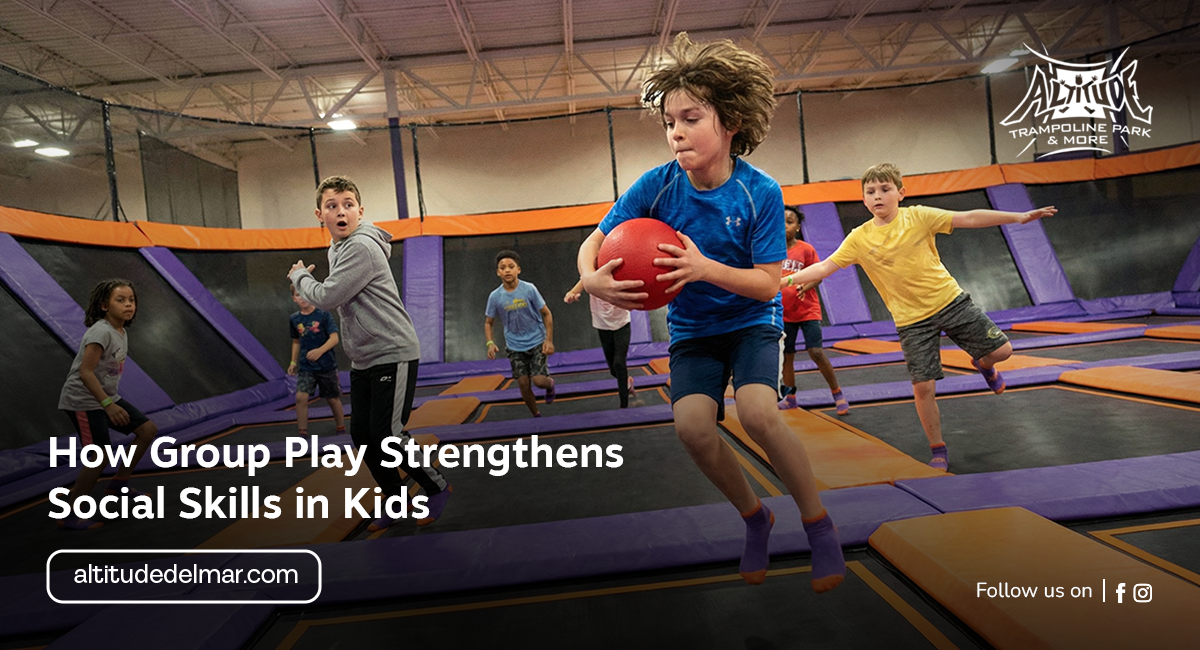
A visit to a place like an indoor trampoline park or community play center gives repeated, varied social interactions in a short period. Use these outings intentionally... Choose team games or group challenges over free play if your goal is social skill development.
.png)
Start small and regular: Weekly 30–60 minute play sessions build more social learning than a one-off all-day party.
Mix ages carefully: If you have a wide age range, choose activities with parallel stations so everyone feels successful.
Teach scripts: Give kids phrases to request, refuse, and apologize. Practice them during calm moments.
Use timers for turns: A simple sand timer teaches fairness and patience.
Rotate leadership: Let different kids lead games so everyone practices being both a leader and a follower.
Debrief briefly. After play, ask, “What was fun? What was hard? What could we try differently?” Reflection builds insight.
Encourage empathy practice. Use prompts like “How do you think Sam felt when that happened?” to deepen emotional awareness.
Group play is a critical learning environment. Children learn social grammar, practice emotional regulation, and rehearse adult-like collaboration. All while having fun. When parents and educators treat play as purposeful practice, the payoff shows up in calmer evenings, smoother classrooms, lasting friendships, and kids who can navigate social life with confidence.
Schedule a short, structured group-play session this week with Altitude Trampoline Park. Let them jump, fall in soft pits, get through ninja course, and win arcade games. Observe the tiny social wins... The way a child says “your turn” without prompting, or a kid helps a friend who fell. Those moments are proof that group play is quietly, powerfully building the social skills kids need to thrive.
The Funfull App
Search for the “Funfull” app and download. Once registered, enjoy your visits to all partnering entertainment venues!.png)
.png)